Showing posts with label Graphics. Show all posts

Friday, August 12, 2016

The Post Game - Dragon Age: Inquisition

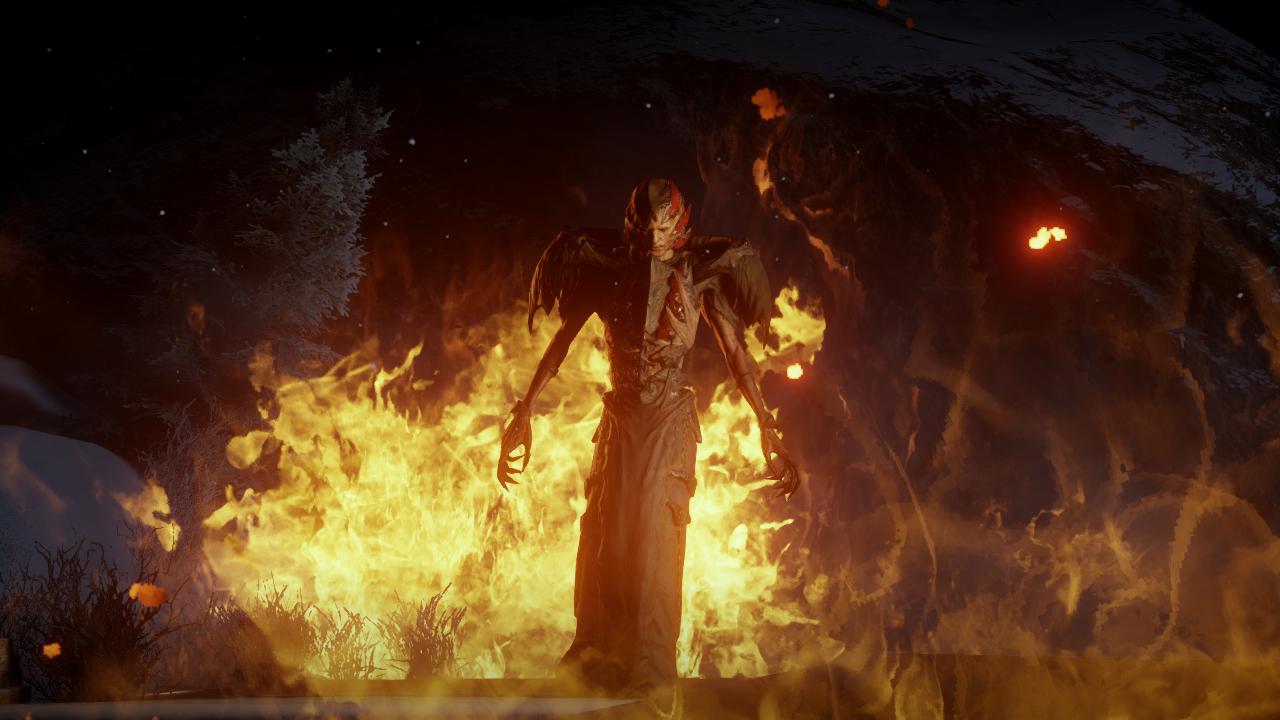
Dragon Age: Inquisition is possessed of a large, beautiful world, some great characters, action-oriented combat and some required grinding for loot. Tactics are there, but are rarely needed. Experiencing the real ending to the game requires the purchase of the Trespasser DLC. A good game whose world is almost too large for its purpose.
Total installed size on my hard-drive (GOTY edition with all DLC): 39.2 GB.

The story, in the best BioWare tradition, is strong and enticing. Fade-rifts are opening all over Thedas.  Some creature known as Corypheus (if you played Dragon Age II, you might remember who he is) seeks to corrupt / gain the power of the land's ruling factions, gathering earthly power unto
himself as he attempts to elevate himself to god-hood. Is he a demon? A magister? Or some new kind of darkspawn? One of his Fade-rites goes badly wrong, and the player-character gets spit out of a rift with some kind magical mark on their left hand. The Chantry's Divine was killed by the rite (or is she merely trapped in the Fade?), leaving confusion and angry factions pointing fingers at each other. In the midst of this, Seeker Cassandra Pentaghast (also from Dragon Age 2) initiates the Inquisition to close the breach in the sky left by Corypheus's rite and seek those who assisted him.

This all happens in the first hour or so of gameplay. BioWare created a fantastic setting of investigation, exploration, and expansion as the Inquisition becomes yours, to be built and used as you see fit. Large-scale faction missions are plotted from the War Room. Completing missions and closing rifts grants Power Points, which can then be spent in the War Room to unlock new areas or undertake main story missions. It's a cool strategy element that kept me thinking about the bigger implications of the search for Corypheus, and the efforts to gain new allies. While this is happening, the Inquisitor builds his / her squad (up to 9 companions are possible), and can spend a large amount
of time talking to them, helping them, and, yes, romancing them (some restrictions apply!). Some characters return from previous games. Varric and Cassandra are selectable squad-mates (both from Dragon Age II). Hawke is not a member of the party, but does join the Inquisitor for a mission. Leliana (from Origins) is an advisor, and has a large supporting role to play; Morrigan appears about half-way through, and like Hawke joins for a mission. There are also call-backs to the previous games in other ways (with the right choices, the ruler of Ferelden will cameo!). It's all the good stuff we've come to expect from BioWare, and they deliver in spades.

“But what about the combat?” you question. “And the grindy looting you referred to?” Read on.


Much of Inquisition is spent exploring areas that are unlocked via the War Room in search of Power Points. While not a sandbox like Skyrim, there are some really large places to go. All are fully explorable; no linear paths in any of them. There are deserts, lush forests, ice plains, and snowy mountains. The missions that fill these areas vary from helping a widow recover her wedding ring to seizing fortresses from Corypheus' Venatori. Inquisition's area design really inspires that “I wonder what's over here” mentality; a lot of time is spent messing about in the game-world, collecting shards, fighting creatures and helping NPCs. And while out exploring, be sure to stop and loot any items you see to acquire “resources” - ore, gems, plants. You'll need them to craft upgrades. Be sure to loot any chests you see as well, because you can't craft something if you don't have the schematic for it. There's so much stuff to loot that it runs the risk of taking over the game. I appreciated the additional gameplay element, but after a while I just wanted to move on with the story. But that's impossible if not enough Power Points have been accumulated to unlock the next major mission. Finding ALL the loot and completing ALL the missions in an area is not necessary to progress through the game, but a decent amount of grind is required. If exploring is your thing, you probably will have plenty of Power Points when you decide to move on to the next mission. If moving quickly through the story is your method, you'll come to resent the required trips into the countryside to do side missions and accumulate Power Points.

Dragon Age Inquisition's combat is a refined version of Dragon Age II's: slick, swift, and action-focused, with little need to pause the game. I liked the combat of Dragon Age II much better than Origins, so to see it developed further was something I appreciated, but if you were a fan of the older system expect to be disappointed. Party AI is quite decent this time around (for mages, anyway; for rogues, not so much). The Tactics menu itself has taken a severe hit, being smaller and with fewer options. If micro-managing the combat was never your thing, prepare to love the combat of Dragon Age: Inquisition. If you were longing for a return to the depth and detail of Origins, prepare to dislike Inquisition's combat – a lot.

On top of this, the final boss of the main campaign (sans DLC) just isn't that impressive. I was expecting the Inquisition's castle to be assaulted, and to fight hordes of demons (and perhaps also darkspawn) in the corridors, fighting up to the highest tower or lowest dungeon, to be greeted with the final boss. This does not happen. There's some teleportation involved, some cool magically shifting landscape, a three-stage battle, and – that's it. It's strangely anti-climatic. It's only after seeing the post-credits scene that we realize who the REAL threat is – but you'll need the Trespasser DLC to deal with them. After all that time spent gathering resources and steeling myself for the implications of the final boss, it is a deliberate fake-out by BioWare. The final boss is over so quickly, and the post-credits reveal occurs so suddenly that if you didn't purchase at least Trespasser, be ready to yell in rage at the obvious DLC-bait.

So Dragon Age: Inquisition is a mixed bag. I love long, grindy games if they're set in a gorgeous world with plenty of things to do. Inquisition delivers by the truck-load. The story is enjoyable, the characters a pleasure. The combat is an evolution of Dragon Age 2's, the final boss is disappointing, and you have to DLC the real ending. Get the Game of the Year Edition, it's the best bargain. Good, but burdened by grinding; 7 out of 10.

Sunday, April 24, 2016

The Post-Game - Ryse: Son of Rome

Hack. Slash. Shield bash. Repeat. That's Ryse: Son of Rome in a nutshell. The more I tried to objectively assemble a list of positives and negatives, the more I realized that Ryse has little unique to offer (those graphics, though!). However, there is real promise in several areas, and I had fun in an arcade-y way. Ryse is worth a purchase at 75% off or more, but certainly not at full price.
What's to like:

The graphics for sure. If you have a killer rig and want an awesome-looking game to showcase your hardware, this is your game. The developers didn't phone in the backdrops, either: the vistas are huge, the backdrops extensive. The undergrowth in Britain is deep, detailed and lush. The water looks like real water, not shiny, shifting, reflective plastic. Character detail is superb, though facial animations still look just a bit stiff.
+ The voice acting is great, and carries the game at many points. Everyone delivers a superb performance (player-character Marius and npc Vitallion are both stand-outs).
+ The story has emotional impact, though if you're at all a fan of the time-period, the careless mixing of old and new legends will probably annoy instead of satisfy. Still, it's enough to keep you moving forward.
+ The soundtrack is a decent emulation of Zimmer's Gladiator score (not surprising).
+ The combat is slick and swift, and easy for newcomers.
+ A lot of effort clearly went into designing the two-player co-operative multiplayer; there are at least a dozen maps and four game modes. It's a lot of fun to team up with someone and slay enemies in the arena, but matchmaking is not that good at the moment, if a match can be found at all.
+ Well-optimized (for Radeon, anyway). In an era of increasingly shoddy PC ports, Ryse ran great on my moderate hardware (A10 6800k + 2GB R7 260X); I averaged around 50fps @1080p Medium settings.

And now, the not-so-awesome stuff.
-  Linear as hell. Rome may look awesome in the distance, but you can't go there.
-  While the story works, even the slightest bit of historical research will reveal there is nothing even approaching “accuracy”. If you were hoping for a cool Roman-era hack'n slash, you'll get it. Historically accurate? Nope. Just a mix of the cool stuff.
-  No real large-scale payoff to the story. Marius has closure, no question. But the larger implications including that he was somehow an instrument of the gods – are never addressed. We just get these god-figures who appear at the end (and are glimpsed throughout) with some decent speeches about purpose, rules, and Rome, and that's it.
-  Combat is limited and repetitive. Hack, slash, shield-bash, repeat. Maybe dodge here and there. It definitely bored me by the sixth chapter (out of eight). A missed opportunity to maybe dual-wield swords, or have a spear and shield, but nope. A sword and shield the entire game.
-  Staying with combat for a minute, finishing moves are a QTE-fest. I don't mean every few minutes; every other second you're performing some kind of QTE. I suppose this was easier than programming more complicated forms of combat.
-  I loved some of the contextual battle choices – where to deploy your archers, advancing on a line of archers in the testudo formation. But these are under-used, and offer little variation.
-  Upgrade skills are ridiculously cheap. I've played enough of the Batman Arkham games to be able to string together a 35-hit combo without much trouble. A big enough combo and correctly-completed QTEs grants tons of “honor” points that are used to level up. If the game were harder, upgrading would have meant more...
-  ...perhaps. Aside from new execution animations, the upgrades didn't seem to have much effect.


Ryse: Son of Rome is a linear hack'n slash that will satisfy in short bursts, but anyone looking for deep gameplay and customization will be disappointed. The potential is there to be something truly great, but sadly that potential remains unrealized.  

Sunday, May 10, 2015

The Post-Game - Deadfall Adventures (Spoilers)

Platforms: Windows, Linux, Xbox 360, Playstation 3

Deadfall Adventures has been sitting in my game library for a while now. It was always a game I meant to play, but somehow never had time to. Well, I took the time - 12 hours to be exact - and I thoroughly enjoyed myself. It's a fun mix of shooter, puzzler, and B-movie Indiana Jones-style setting / action / dialogue. If that sounds appealing, the game is worth picking up when on sale for around $10.

Note that I only played the single player campaign. I will evaluate the multiplayer at some point in the future.
That is if I feel motivated to try it out before needing the hard-drive space for other games.
And that's if there is anyone in the multi-player lobbies to even play multi-player with.


Gameplay
+ Decent gun-play. Different weapons feel different. 
+ Well-designed levels. Though linear overall, the levels tend to be large with plenty of cover and opportunities for flanking. 
+ Destructible cover. Not all cover is destructible, but plenty is.
+ Environment kills. Shoot explosive barrels, generators and gas cans to trigger explosions. Or, even better: those Mayan traps you just spent five minutes avoiding? Trigger them to kill the enemies coming after you.
+ Great puzzle design. These are the kinds of puzzles that I wish were in the new Tomb Raider (2013). Mirror puzzles, the "tile" puzzles on the floor (put a foot wrong and you die), going up and down on a platform, trying to pull levers in the correct order - all are core elements of Deadfall Adventures, and are required to progress in the story. None of the puzzles are greatly proliferated, either - some are variants on a theme (I counted three bounce-the-light-on-the-mirrors puzzles). Helps keep things fresh and interesting.
+ Fighting non-human enemies is reminiscent of Alan Wake's "fight with light" technique. Shine a flashlight (or other light-source - there are environment triggers for this as well), heat them up, and they start to burn. Once the burn effect begins, shooting them will have an effect. 

+ / - No cover system. Crouch behind cover, but no "snap-to" cover system. Not an outright negative because it can be argued that the game doesn't need it.
+ / - Same for dodging. Not in the game, but Deadfall Adventures is not built around melee combat anyway.
+ / - Not too short. A short campaign is one of the primary criticisms of the game. I got 12 hours out of a single playthrough, taking my time with puzzles and looking for treasure. Speedsters can complete the game in a third of that time, but atmosphere and environment is one of the points of the game. If you don't take time to savor either, and play the entire game with a game-guide providing all the puzzle solutions, expect to be disappointed by Deadfall Adventures.

- Low replayability. Once you've played it, no reason to revisit it except for achievement grinding.
- Some levels are pure corridor shooters. Boring. Thankfully, there are not many of these.
- No manual saving of the game. Checkpoints are fairly frequent, but still annoying.
- The loot system. It is completely tied into the upgrade system. Find treasure, and use it to upgrade Quartermain's skills. Treasure is only found by exploring every nook and cranny of the (generally linear) levels. Taking time out of the main quest is something I like to do for fun if I am enjoying the game; don't force me to do it as a condition of upgrading my character's skills. Finding treasure became a chore. I missed out on several upgrades just because I couldn't be bothered to complete the puzzle to uncover the treasure. Completionists will thrive here, but those looking to maintain momentum in their game won't want to take time out to find all the treasure. Which will preclude them from fully upgrading Quartermain.
- Reflexes required. Not always, but there are a few puzzles that rely on a player's reflexes to pass through them. Something to keep in mind if you're playing with an old keyboard + mouse and have issues with input lag.
- Puzzles may have great design, but sometimes there is simply no indication how to solve them. The in-game notebook that Quartermain consults when faced with a puzzle is usually helpful, but there are several occasions where it was not - and one occasion where the notebook was wrong. 
- Sometimes there are no clues on how to progress. Not always a problem, but it comes up at a few crucial points. The easiest example is the final boss. (minor SPOILER) At the second stage of the fight, with lava being shot everywhere, the boss is invincible. I ran around in circles for fifteen minutes, shooting at the boss and his minions, unsure if I was actually damaging him with gunfire, or whether by shooting his minions he was taking damage, or maybe I had to kill several waves of minions for him to take damage... Nope, none of that. Finally, I looked up a game-play guide and learned that, upon entering that stage of the battle, I was supposed to shoot out some support columns high in the air to collapse the ceiling on him. Maybe I would have figured it out after a while, but things like this happened several times throughout the game. That's not poor design - the design works well enough - that's poor implementation.
- Minimal upgrade tree. There are five upgrade paths, each of four levels. Not enough variety.
The entire upgrade screen.
- No in-game indicator of how to proceed through a level. Not looking to have my hand held, no. I wanted to finish an area, then go back and search for treasure. Sometimes I would be digging around, exploring some passageways, and trigger the next area - which locked me out of the previous one. Bye-bye upgrades.

Characters
+ If you can accept Deadfall Adventures as a B-movie kind of experience, Quartermain is snarky and sarcastic, his side-kick Jen is hot but capable, and the villain is a real scumbag who gets what is coming to him. Quartermain is your strong alpha-male type who prefers guns and bullets to puzzles and finesse (at one point he actually says, "I hate pushing buttons!" Except I had him push the wrong one, so he died instantly!). Jennifer Goodwin is smart and savvy, who provides the sense to complement Quartermain's direct simplicity. Aside from the villains, there aren't really any other characters in the game worth mentioning.

- If you can't accept the game as a B-movie kind of experience, you'll notice that Quartermain's voice actor is not that good, Jennifer Goodwin sounds like a cheap rip-off of Rachel Weisz in The Mummy, and the villains do absolutely everything you expect them to do. How many male-stereotypes have been seen in movies or in games that prefer bullets and explosions over any other approach? And how many times have we seen the woman thrust into a complimentary role to the alpha-male, balancing him and supporting him on his journey? Both are over-played tropes that rear their heads here once again. 

Narrative
+ / - You've heard the story before. Nazis are after some secret artifact that will give them power over the world. If plays out pretty much as you would expect it to: initial exploration, discovery of more pieces of the puzzle, betrayal, follow the villain to the next important piece, he gets there first, girl gets captured once or twice, rescue girl, get the artifact, kill the Nazis, save the world. Deadfall Adventures uses the story as an excuse to visit some exotic locations, and these locations are wonderfully detailed, but don't expect original story-telling.

Graphics Etc.
+ Environment graphics are superb. The Arctic looks cold, with great water / ice effects and blowing snow. The jungles are densely populated with lots of foliage, and the numerous ruins we explore are perfectly rendered with that aged, moss-covered look. 
+ Weapon models are well designed and detailed.
+ Except for the fact that Jennifer Goodwin's clothes look a little tight, they are at least practical and fit within the story. 
+ The game was very stable, not a single crash in the entire play-through.

+ / - Heavy on system resources. I was surprised to find that Deadfall Adventures stressed my system as much as The Witcher 2 (60% CPU, 100% GPU load)(A10 6800k + R7 260X). The game does look amazing, though, so I suppose that is not a surprise.
+ / - Voice acting is hit-or-miss. Quartermain's voice flip-flops between "I'm bored but I'm awesome anyway..." to "Hell yeah! look how big that explosion was!" Blech. The main villain's voice actor hits all the right notes, though, and Jen's voice actress comes off well enough.
+ / - Soundtrack is good, but not enough variety. Some tracks get repetitive, depending on how much time you spend in a location.

- Character models are disappointing. Stiff and low-res.
- Over-priced. I thought Deadfall Adventures was fun, but $50 for the Deluxe Edition? even at 75% off ($12.50), that is still more than the game is worth. Drop the Deluxe Edition to $7.50-$10 at 75% off, and the game becomes a must-buy when on sale.
- At the time of writing, there is no option to upgrade to the Deluxe Edition in the Steam store. I liked the game, why not provide a Deluxe Edition Upgrade option? As a result, I'm missing out on some DLC, multiplayer skins, behind-the-scenes extras, and soundtrack. I can't get the Deluxe Edition by purchasing it - Steam says I already own the game. So... I guess there is no legitimate way to get those extra materials.

Friday, March 13, 2015

Ever Wondered What Your Graphics Card Does?

Found this great analysis that examines just what goes into rendering a single frame of a game. The game used for the example was Deus Ex: Human Revolution.

http://www.adriancourreges.com/blog/2015/03/10/deus-ex-human-revolution-graphics-study/

I think many people (myself included) simply don't appreciate the sheer amount of computing power at our fingertips these days.